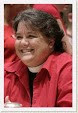
The Rev. Canon Debbie Royals is an Episcopal priest and a member of the Pascua-Yaqui tribe. Listen to how she understands these two cultures forming a single spirituality.
Friday, February 15, 2019

Thursday, March 1, 2018
Contagious!
I had a wonderful Sunday a few weeks ago at St. Francis Episcopal Church in Green Valley, AZ. Their congregation is a supporter of Imago Dei Middle School, where I am serving as chaplain. Our work with low income students demands that we seek solutions to the larger economic issues that their families face. I think Jesus would support those efforts!
(I recorded this after the fact in the school chapel, so imagine congregation noise in the background!)
(I recorded this after the fact in the school chapel, so imagine congregation noise in the background!)
Wednesday, February 3, 2016
Heavenly Marriage Feast
I had a good time at St. Thomas of Canterbury Episcopal Church in Albuquerque last month. It happened to be the Sunday after the Anglican Primates sought to reprimand the Episcopal Church for embracing marriage equality. I thought the lessons were a perfect response.
Sunday, September 20, 2015
Transfigured for Justice
I supplied at Covenant Presbyterian Church in Albuquerque on August 9th. I used the lessons for the Feast of the Transfiguration, because they're too good to miss! Exodus 34:29-35, 2 Peter 1:13-21, and Luke 9:28-36
Sunday, August 16, 2015
The Poor will be Raised up
I'm trying something new, and trying it out here. My job as the Executive Director of the New Mexico Conference of Churches means I don't preach every week. But I can't help thinking about what I would say about various lessons. So, I'm trying podcasting. I've thought about this for a long time. I'm not sure I've figured out what is worth posting and listening to, so expect a variety of things. Let me know if there's something you really like - I'll try to do more of it.
I hope to post conversations with people I like and admire. And I expect there will be a fair amount of politics. I'm doing this on my own time with my own resources. That means I'm free to say what I want, what I think needs to be said. Many preachers are shy about politics because they don't want to offend the people who pay their salary. Churches' tax exempt status means that they can't support particular political candidates or parties. I don't have either of those constraints, so look out!
My first attempt comes on August 15th, the Feast of St. Mary the Virgin. So here are a few thoughts. Be patient as I get better using the technology!
I hope to post conversations with people I like and admire. And I expect there will be a fair amount of politics. I'm doing this on my own time with my own resources. That means I'm free to say what I want, what I think needs to be said. Many preachers are shy about politics because they don't want to offend the people who pay their salary. Churches' tax exempt status means that they can't support particular political candidates or parties. I don't have either of those constraints, so look out!
My first attempt comes on August 15th, the Feast of St. Mary the Virgin. So here are a few thoughts. Be patient as I get better using the technology!
Tuesday, May 14, 2013
Maroc, continued
One of the best parts of our trip across Morocco was our guide, Omar. He's led Semester at Sea trips before, though most of the time he leads small private tours for diplomats, CEOs and the like. The morning after the camel trek, back in Marrakech, Omar offered to lead a cultural tour through the medina. A small group of people took him up on it which made for a great experience.
He took us to the oldest part of the medina, or old city, to meet some traditional artisans. The first was a 13th century wood carvers shop, where a man used his hands and feet to operate a lathe on the ground and turn tiny dowels into delicate beads and rings. We saw a traditional community bakery still in operation, because the bread tastes better baked this way, Omar said.

The highlight of the morning was the rug coop. This establishment markets rugs from all over the country. We were warmly welcomed and invited to take seats around the enclosed courtyard, where the show began. One man began to tell us about how the rugs were made as others dramatically pulled rolled up carpets from the stacks surrounding them and unrolled them with a flourish.
The speaker identified the tribe that made each rug and pointed out the features unique to that tribe's style. It was fun to see who gravitated toward which rugs. We all had different favorites. After the show, we were encouraged to wander around the towering stacks and choose the rug we wanted. At one point, as I was looking at a rug I liked and trying to calculate the exchange rate of Dollars to Dirham, the salesman said, "don't look with your eyes, but your heart!" I heard others ask, "which one do you love?" It's a good technique. It also illustrated the real value of the rugs. The actual cost of the rugs was pretty dear, too. With Omar's help I was able to get a small rectangular rug made in two styles - flat weave and knotted - in muted red and blue. At one point the haggling seemed to be escalating. I told Omar to say I was a poor teacher who could not afford a big price! With that the man in charge said okay, "You deserve it!" And cheered from the balcony over looking the courtyard.
Time was quickly evaporating so Omar hurried us through the medina headed toward an area of souks, or shops, where he trusted the owners to give us good deals. Our passage was slowed by a donkey cart that was having trouble staying on the cobbled road and between the souks. Eventually we wandered into an open area with an aromatic spice shop.

Omar guided us away from the snake charmers and the more garish tourist traps and instead gave us a glimpse into the history of this ancient society and the people who uphold it.
We eventually headed back to Casablanca and its crowded streets and industrial smog. The ship has become home now, and we were all eager to get back to our cabins and wash off the desert. The next morning many of us took off along the coast for a tour of the mosque.
The Hassan II Mosque is named after the late King of Morocco and took about 6 years to build. It claims to be the third largest in the world, behind those in Mecca and Medina. It is a stunning creation that makes the largest Christian cathedrals look quaint. When we first drove past it at the beginning of the week the weather was beautiful and clear, showing off the mosque. The day of our tour was foggy and damp and the top of the mosque itself and its minaret (the tallest in the world) were completely obscured.


The building is an interesting mix of ancient customs and artistry and modern engineering. The wooden ceiling is retractable, like a football arena, and on this morning it was open to air out the mosque. Additionally, there are several large titanium and bronze doors that raise and lower like garage doors, though much bigger and heavier! The building sits right on the coast and extends over the water, recalling the Quran's description that the throne of God was built on the water. Glass doors look out over the sea. Below there is a huge ablutions room for men, and public baths, or hammams, for men and women.

Over 100,000 people can gather at the mosque - about 20,000 inside and the rest in the outside courtyards, among the fountains. At night, a bright green laser points from the top of the minaret toward Mecca, telling everyone in Casa what direction to pray. It is one of the only mosques in Morocco that non-Muslims are permitted to enter, including women. We appreciated the hospitality of the community to allow us to see this magnificent building. It somehow seemed to be both opulent and sparse at the same time. No doubt something made possible by its sheer size.
As we were arriving in Morocco we were aware of the controversy heating up in the States about the man in Florida who was planning to burn Qurans. We realized that we would be traveling on September 11 and we were warned to be careful. At times we experienced a distinct hostility toward us, whether because we were loud Americans, or non-Muslims, or immodestly dressed we did not know. However, on Sept 10, the first day of Eid, when we were in Marrakech, I had a conversation with a shop owner (in French!) about the proposed Quran burning. The shop owner, who was about my age, told me that the Quran is given by God and is something that one lives. To burn a Quran is dumb because the paper is unimportant. We wipe our hands with paper, he said. I agreed with him about how dumb this act is, and said that the Bible too is something that is lived and not merely written down. After the warnings we'd received, I was very grateful for this exchange and some shared understanding. I was also grateful that he was willing to make a distinction between us and the fool in Florida!
Soon we were back on the ship and heading south toward Ghana.
He took us to the oldest part of the medina, or old city, to meet some traditional artisans. The first was a 13th century wood carvers shop, where a man used his hands and feet to operate a lathe on the ground and turn tiny dowels into delicate beads and rings. We saw a traditional community bakery still in operation, because the bread tastes better baked this way, Omar said.

The highlight of the morning was the rug coop. This establishment markets rugs from all over the country. We were warmly welcomed and invited to take seats around the enclosed courtyard, where the show began. One man began to tell us about how the rugs were made as others dramatically pulled rolled up carpets from the stacks surrounding them and unrolled them with a flourish.

The speaker identified the tribe that made each rug and pointed out the features unique to that tribe's style. It was fun to see who gravitated toward which rugs. We all had different favorites. After the show, we were encouraged to wander around the towering stacks and choose the rug we wanted. At one point, as I was looking at a rug I liked and trying to calculate the exchange rate of Dollars to Dirham, the salesman said, "don't look with your eyes, but your heart!" I heard others ask, "which one do you love?" It's a good technique. It also illustrated the real value of the rugs. The actual cost of the rugs was pretty dear, too. With Omar's help I was able to get a small rectangular rug made in two styles - flat weave and knotted - in muted red and blue. At one point the haggling seemed to be escalating. I told Omar to say I was a poor teacher who could not afford a big price! With that the man in charge said okay, "You deserve it!" And cheered from the balcony over looking the courtyard.
Time was quickly evaporating so Omar hurried us through the medina headed toward an area of souks, or shops, where he trusted the owners to give us good deals. Our passage was slowed by a donkey cart that was having trouble staying on the cobbled road and between the souks. Eventually we wandered into an open area with an aromatic spice shop.

Omar guided us away from the snake charmers and the more garish tourist traps and instead gave us a glimpse into the history of this ancient society and the people who uphold it.
We eventually headed back to Casablanca and its crowded streets and industrial smog. The ship has become home now, and we were all eager to get back to our cabins and wash off the desert. The next morning many of us took off along the coast for a tour of the mosque.
The Hassan II Mosque is named after the late King of Morocco and took about 6 years to build. It claims to be the third largest in the world, behind those in Mecca and Medina. It is a stunning creation that makes the largest Christian cathedrals look quaint. When we first drove past it at the beginning of the week the weather was beautiful and clear, showing off the mosque. The day of our tour was foggy and damp and the top of the mosque itself and its minaret (the tallest in the world) were completely obscured.


The building is an interesting mix of ancient customs and artistry and modern engineering. The wooden ceiling is retractable, like a football arena, and on this morning it was open to air out the mosque. Additionally, there are several large titanium and bronze doors that raise and lower like garage doors, though much bigger and heavier! The building sits right on the coast and extends over the water, recalling the Quran's description that the throne of God was built on the water. Glass doors look out over the sea. Below there is a huge ablutions room for men, and public baths, or hammams, for men and women.

Over 100,000 people can gather at the mosque - about 20,000 inside and the rest in the outside courtyards, among the fountains. At night, a bright green laser points from the top of the minaret toward Mecca, telling everyone in Casa what direction to pray. It is one of the only mosques in Morocco that non-Muslims are permitted to enter, including women. We appreciated the hospitality of the community to allow us to see this magnificent building. It somehow seemed to be both opulent and sparse at the same time. No doubt something made possible by its sheer size.
As we were arriving in Morocco we were aware of the controversy heating up in the States about the man in Florida who was planning to burn Qurans. We realized that we would be traveling on September 11 and we were warned to be careful. At times we experienced a distinct hostility toward us, whether because we were loud Americans, or non-Muslims, or immodestly dressed we did not know. However, on Sept 10, the first day of Eid, when we were in Marrakech, I had a conversation with a shop owner (in French!) about the proposed Quran burning. The shop owner, who was about my age, told me that the Quran is given by God and is something that one lives. To burn a Quran is dumb because the paper is unimportant. We wipe our hands with paper, he said. I agreed with him about how dumb this act is, and said that the Bible too is something that is lived and not merely written down. After the warnings we'd received, I was very grateful for this exchange and some shared understanding. I was also grateful that he was willing to make a distinction between us and the fool in Florida!
Soon we were back on the ship and heading south toward Ghana.
Maroc
Morocco was fascinating and befuddling. We docked in the Casablanca port, which unlike Cadiz, is a busy industrial port. It was not beautiful. Rather it was dirty and dusty, on the edge of a city of 5 million people. Casa (as it's called) is the commercial center of Morocco and is not designed for foreign tourists!
We arrived on Sept. 9, the last day of Ramadan, so most things were closed during the day. And because of the nature of Casa, most people on the ship were getting ready to head across the country one way or another. We had a diplomatic briefing by two US Embassy officials who were engaging and patiently answered the many questions about how to find ATM's and how to exchange money, etc., etc. Unlike Cadiz, many people stayed on the ship the first day as we got ready to travel on the 10th.
The 10th was also the first day of Eid-al-Fitr. As my trip was leaving Casa the whole city, it seemed, was streaming home from the magnificent Hassan II mosque. It is the largest mosque in Morocco and one of the largest in the world. More about that later!

From Casa my bus (and the one in front of it) was headed to Marrakech for our first night. Our first stop was in the city square where we were having lunch.

45 students streamed off our tour bus and were instantly accosted by people in traditional dress asking for money in exchange for pictures with them. Several men were draping snakes around unwitting tourists while others coaxed trained monkeys onto their shoulders. The population of Marrakech is 1.5 million, and at any one time there are an additional 1 million tourists there. So these folks knew what they were doing! Some students were delighted, others were not. I protectively herded several as they were trying to pull a few bills out of their money belts as the salesmen eagerly watched. There were also women in traditional Muslim dress with only their eyes visible, catching women's hands and decorated them with henna before the young women even knew what was happening. At that point it was too late for them to say No, and they felt caught and obligated to pay the price the henna artist asked, or demanded. It was a shocking introduction to Moroccan salesmanship! Some students became expect bargainers, others hated the whole experience. I successfully avoided the monkeys, snakes, and henna and waited to shop when our tour guide could help me out with the haggling!
After separating ourselves from the entrepreneurs, we had the first of many wonderful Moroccan meals. We would all sit down while the wait staff brought out the pre-ordered set menu for the 90 people from both tour buses. Each meal began with a plate of cold salad items - strips of pickled carrot, cucumber slices, tomatoes, and sometimes bell pepper slices, avocado, or a lemony cole slaw. The meals are served family style, so each person at the table serves him or herself from the main plate. After the salad plate was whisked a way, a waiter would place a covered tajine in the middle of the table and then dramatically pull the cover off.


This one was a Berber dish of ground lamb in a tomato base, with scrambled egg on top. It was better than it sounds, and than I expected! One student said he wanted to buy a tajine because every time one appeared and the lid was lifted there was something delicious inside. He wondered if it would work like that at home!
The next day we drove about 7 hours across the country toward Zagora near the southern border of Algeria and on the edge of the Sahara desert. The high desert reminded me so much of New Mexico it was eerie. We passed many villages clustered together in the vast landscape. Then we crossed the Atlas Mountains, with breathtaking vistas. And not a little motion sickness. Our bus actually slowed down because of the several people puking. (Not me this time!)

After dark we arrived at the Nomad Camp and were greeted with singing and drumming from a traditional Moroccan musical group (who's name I did not learn.) We were then offered the traditional mint tea and allowed to settle into our tents. Berber carpets formed the center courtyard with 6 person tents situated in rows around the center. The tents were made out of heavy blankets stitched together, with carpets on the floor. The mattresses were better than the beds in the hotel! We had another delicious meal from the magic tajines and then more singing and drumming from the musicians.

We were awoken early the next morning by the braying of donkeys - which I haven't heard since Girl Scout Camp - and whatever you call the sound that camels make! After breakfast (boiled eggs, fruit, & bread) we were put into small groups for the camel trek. The best part of riding a camel is getting on and getting off!

One climbs onto the camel when its on the ground and then hangs on for dear life as it stands up, tipping its rider far backward. Getting off is the same thing in reverse. One hangs on tightly while the camel kneels down on its front knees, tipping the rider far forward. It helps to have a camel herder brace your shoulders! Everything in between is less exciting and less comfortable. I commented that there is a real need for more research and development on camel saddles! They were basically a metal brace the fit over the camel and provided the handlebar, with heavy blankets over it. We all had bruises from sitting on the "saddle." The ride is less rhythmic than a horse - or maybe it's just that a camel sways more in every direction so its harder to stay centered and adjusted. I'd kind of get the hang of it, and then list off to one side or the other and have to get readjusted, all while continuing to sway. I'm so glad I did it, and I probably don't need to do it again! We did learn that Timbuktu was 52 days away by camel. We rode for less than 1 hour and decided Timbuktu would have to wait!

We rode through stands of date palms - some were able to pick some and eat them - and around communities of people who looked at us like the crazy tourists were were. We saw several cars and motorbikes to underscore that point! We also saw lots of children delighted by the spectacle, and a lot of sheep and goats. I understand now why Jesus told a parable about separating them - they run around together and are almost indistinguishable until you get up close.
After the camel trek we had a long drive back to Marrakech, through some different and equally amazing terrain, especially in the middle Atlas.

In the next post - hopefully later today - I'll talk about our cultural shopping tour in Marrakech and the Hassan II mosque in Casablanca.
We arrived on Sept. 9, the last day of Ramadan, so most things were closed during the day. And because of the nature of Casa, most people on the ship were getting ready to head across the country one way or another. We had a diplomatic briefing by two US Embassy officials who were engaging and patiently answered the many questions about how to find ATM's and how to exchange money, etc., etc. Unlike Cadiz, many people stayed on the ship the first day as we got ready to travel on the 10th.
The 10th was also the first day of Eid-al-Fitr. As my trip was leaving Casa the whole city, it seemed, was streaming home from the magnificent Hassan II mosque. It is the largest mosque in Morocco and one of the largest in the world. More about that later!

From Casa my bus (and the one in front of it) was headed to Marrakech for our first night. Our first stop was in the city square where we were having lunch.

45 students streamed off our tour bus and were instantly accosted by people in traditional dress asking for money in exchange for pictures with them. Several men were draping snakes around unwitting tourists while others coaxed trained monkeys onto their shoulders. The population of Marrakech is 1.5 million, and at any one time there are an additional 1 million tourists there. So these folks knew what they were doing! Some students were delighted, others were not. I protectively herded several as they were trying to pull a few bills out of their money belts as the salesmen eagerly watched. There were also women in traditional Muslim dress with only their eyes visible, catching women's hands and decorated them with henna before the young women even knew what was happening. At that point it was too late for them to say No, and they felt caught and obligated to pay the price the henna artist asked, or demanded. It was a shocking introduction to Moroccan salesmanship! Some students became expect bargainers, others hated the whole experience. I successfully avoided the monkeys, snakes, and henna and waited to shop when our tour guide could help me out with the haggling!
After separating ourselves from the entrepreneurs, we had the first of many wonderful Moroccan meals. We would all sit down while the wait staff brought out the pre-ordered set menu for the 90 people from both tour buses. Each meal began with a plate of cold salad items - strips of pickled carrot, cucumber slices, tomatoes, and sometimes bell pepper slices, avocado, or a lemony cole slaw. The meals are served family style, so each person at the table serves him or herself from the main plate. After the salad plate was whisked a way, a waiter would place a covered tajine in the middle of the table and then dramatically pull the cover off.


This one was a Berber dish of ground lamb in a tomato base, with scrambled egg on top. It was better than it sounds, and than I expected! One student said he wanted to buy a tajine because every time one appeared and the lid was lifted there was something delicious inside. He wondered if it would work like that at home!
The next day we drove about 7 hours across the country toward Zagora near the southern border of Algeria and on the edge of the Sahara desert. The high desert reminded me so much of New Mexico it was eerie. We passed many villages clustered together in the vast landscape. Then we crossed the Atlas Mountains, with breathtaking vistas. And not a little motion sickness. Our bus actually slowed down because of the several people puking. (Not me this time!)

After dark we arrived at the Nomad Camp and were greeted with singing and drumming from a traditional Moroccan musical group (who's name I did not learn.) We were then offered the traditional mint tea and allowed to settle into our tents. Berber carpets formed the center courtyard with 6 person tents situated in rows around the center. The tents were made out of heavy blankets stitched together, with carpets on the floor. The mattresses were better than the beds in the hotel! We had another delicious meal from the magic tajines and then more singing and drumming from the musicians.

We were awoken early the next morning by the braying of donkeys - which I haven't heard since Girl Scout Camp - and whatever you call the sound that camels make! After breakfast (boiled eggs, fruit, & bread) we were put into small groups for the camel trek. The best part of riding a camel is getting on and getting off!

One climbs onto the camel when its on the ground and then hangs on for dear life as it stands up, tipping its rider far backward. Getting off is the same thing in reverse. One hangs on tightly while the camel kneels down on its front knees, tipping the rider far forward. It helps to have a camel herder brace your shoulders! Everything in between is less exciting and less comfortable. I commented that there is a real need for more research and development on camel saddles! They were basically a metal brace the fit over the camel and provided the handlebar, with heavy blankets over it. We all had bruises from sitting on the "saddle." The ride is less rhythmic than a horse - or maybe it's just that a camel sways more in every direction so its harder to stay centered and adjusted. I'd kind of get the hang of it, and then list off to one side or the other and have to get readjusted, all while continuing to sway. I'm so glad I did it, and I probably don't need to do it again! We did learn that Timbuktu was 52 days away by camel. We rode for less than 1 hour and decided Timbuktu would have to wait!

We rode through stands of date palms - some were able to pick some and eat them - and around communities of people who looked at us like the crazy tourists were were. We saw several cars and motorbikes to underscore that point! We also saw lots of children delighted by the spectacle, and a lot of sheep and goats. I understand now why Jesus told a parable about separating them - they run around together and are almost indistinguishable until you get up close.
After the camel trek we had a long drive back to Marrakech, through some different and equally amazing terrain, especially in the middle Atlas.

In the next post - hopefully later today - I'll talk about our cultural shopping tour in Marrakech and the Hassan II mosque in Casablanca.
Subscribe to:
Posts (Atom)